Dzukou Valley Trek: Routes, Permits and Best Time for 2026
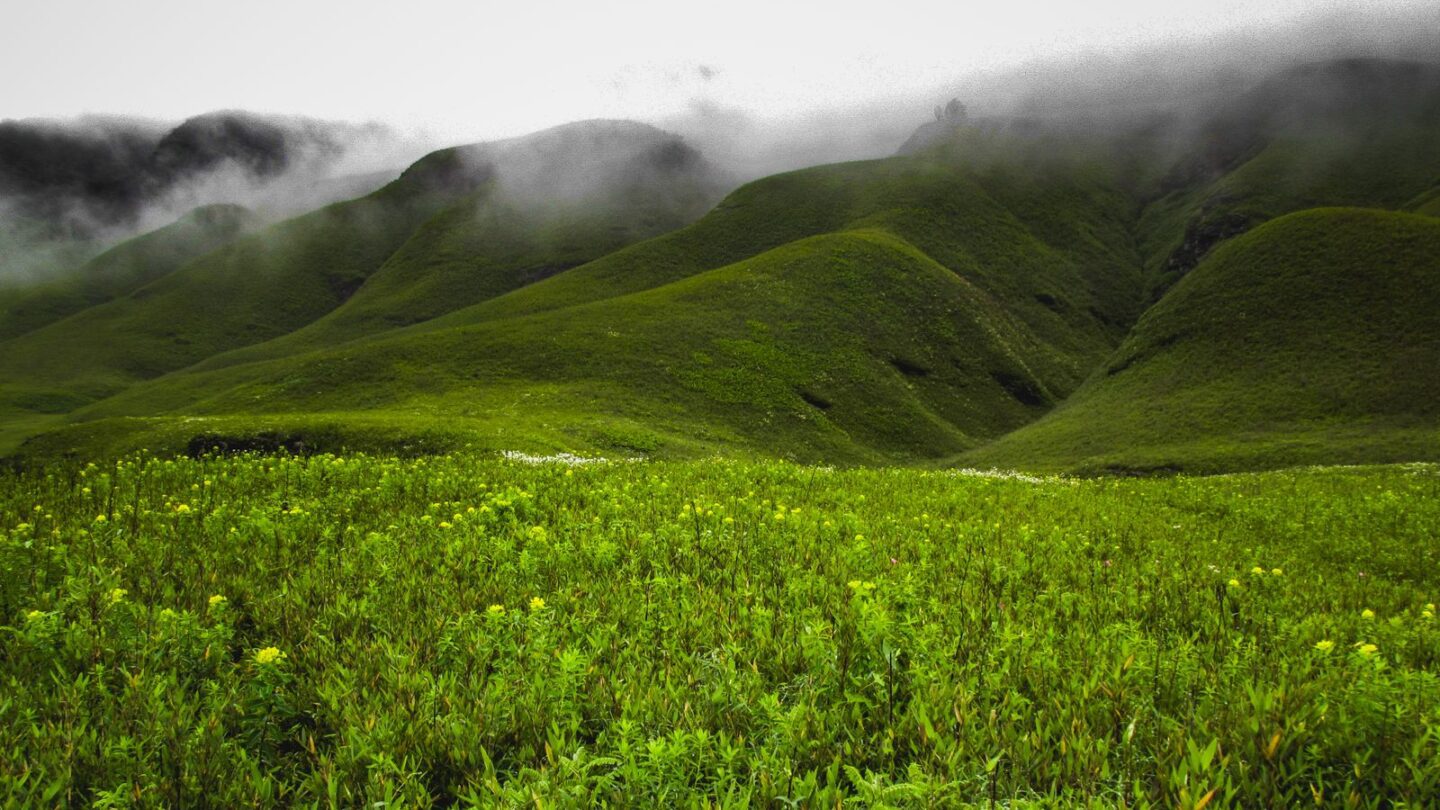
The Dzukou Valley trek is a one- or two-day hike south of Kohima to a grassy valley at about 2,450 m (8,045 ft) on the Nagaland–Manipur border. It starts from Viswema or Jakhama, and most walkers reach the rest house in roughly 3 to 6 hours. Since 1 October 2025, every Dzukou Valley trek needs a guide registered with the Southern Angami Youth Organisation (SAYO).
The valley is famous for its rolling hills of dwarf bamboo, winding streams and the rare Dzükou lily. It sits in Kohima district, and SAYO manages access, the rest house and trail rules. Indian visitors from outside Nagaland also need a Nagaland ILP, while foreigners need a Protected Area Permit.
Key takeaways
- The Dzukou Valley trek reaches a valley at about 2,450 m, roughly 20 to 25 km by road from Kohima to the trailheads.
- Viswema is the gentler, more popular route; Jakhama is shorter but climbs steeply on stone steps.
- A SAYO-registered guide is mandatory, and no trekking is allowed after 3 pm in winter or 4 pm in summer.
- Indians from outside Nagaland need an ILP (₹200 for 30 days); foreign nationals need a PAP.
- Wildfires hit parts of the valley in December 2025 and from late January 2026, and fire rules are now strict.
Dzukou Valley trek at a glance
| Detail | Information |
|---|---|
| Location | Kohima district, Nagaland, on the Manipur border |
| Valley altitude | About 2,450 m (8,045 ft) |
| Main trailheads | Viswema and Jakhama (also spelt Zakhama) |
| Distance from Kohima | Roughly 20 to 25 km to either trailhead |
| Time to rest house | About 3 to 4 hours via Viswema; 4 to 5 hours via Jakhama |
| Difficulty | Easy to moderate, with one steep section on each route |
| Managed by | Southern Angami Youth Organisation (SAYO) |
| Guide | Mandatory since 1 October 2025 |
| Permit for Indians | Nagaland ILP, ₹200 for 30 days |
| Permit for foreigners | Protected Area Permit |
| Stay | Trekkers’ rest house (dormitory and rooms) or camping |
| Best time | October to November; June to July for flowers |
Where the Dzukou Valley is and why it is famous
Dzükou Valley lies in the Barail hills, south of Kohima and behind the Japfü range. The name is often written as Dzükou, Dzukou or Dzüko. Its northern approach belongs to the lands of the Southern Angami villages, such as Viswema, Jakhama and Kigwema. Our guide to Nagaland tribes explains the Angami and other Naga communities of the area.
The valley has no villages or roads. Instead, low hills of dwarf bamboo roll above a clear stream. As a result, the Dzukou Valley trek looks green in the monsoon and gold in winter.
The valley also lies near a long-disputed Nagaland–Manipur boundary. Visitors rarely notice this, but it explains why some maps differ.
The Dzükou lily
The Dzükou lily, usually named Lilium chitrangadae, is a pink-white lily found in the upper parts of the valley. Researchers first recorded it in 1991. Some botanists treat it as close to, or the same as, the Shirui lily of Manipur. Local reports say invasive dwarf bamboo and fires have reduced its numbers. Therefore, never pick flowers or step off the trail to photograph them.
Dzukou Valley trek routes: Viswema vs Jakhama
Two main Dzukou Valley trek routes start from National Highway 2, south of Kohima. Both reach the same rest house, so many trekkers go up one way and down the other. Additionally, a six-hour route enters from Manipur’s Senapati district, but it needs an experienced local team.
| Factor | Viswema route | Jakhama route |
|---|---|---|
| Road from highway | About 8 to 9 km of rough road, by taxi | About 3 to 4 km of road |
| Walking time up | About 3 to 4 hours | About 4 to 5 hours |
| Steep section | 45 minutes to 1.5 hours at the start | Most of the climb, on stone steps |
| Views | Long ridge walk with valley views | Dense forest, fewer views |
| Best use | Going up, first-time trekkers | Coming down, fitter walkers |
| Descent time | About 3 hours | About 3 hours |
These times come from trek operators and trekker reports, and they vary with fitness, weather and group size. In contrast, a wet trail can add an hour or more.
Viswema route
Viswema is the older and more popular Dzukou Valley trek approach. A taxi from the highway climbs a rough road for about 8 to 9 km to the trail start. From there, a steep, often muddy path climbs through forest for roughly 45 minutes to an hour and a half. After that, the trail follows a ridge for about two hours, with the valley opening up below. Consequently, most first-timers begin their Dzukou Valley trek on this side.
Jakhama route
The Jakhama route starts close to the Jakhama check post on the highway. After a short drive, the path climbs steadily on rough stone steps through thick forest. Many describe it as harder going up but easier going down. Therefore, a common Dzukou Valley trek plan is up via Viswema and down via Jakhama.
Dzukou Valley trek permits and the mandatory guide rule
Your Dzukou Valley trek permit depends on who you are. Nagaland keeps an Inner Line Permit system for Indian citizens from outside the state, and checks can happen on the highway and at hotels. Our Nagaland ILP guide explains the online process step by step.
| Traveller | Document needed | Notes |
|---|---|---|
| Resident of Nagaland | Photo ID | Carry original ID |
| Indian tourist from outside Nagaland | Nagaland ILP | ₹200 for 30 days, apply online |
| Foreign national | Protected Area Permit | Reimposed in Nagaland in December 2024 |
| Every trekker | SAYO-registered guide | Mandatory since 1 October 2025 |
For foreigners, the Protected Area Permit regime returned to Nagaland in December 2024. The state assembly urged the Centre to withdraw it in September 2026. However, check the current rule with an approved operator before you book. For a region-wide view of permits, read our explainer on the Inner Line Permit in Northeast India.
The SAYO guide and timing rules
SAYO said in September 2025 that unguided trekkers often got lost, forcing risky night rescues. As a result, every Dzukou Valley trek from 1 October 2025 needs a SAYO-registered guide. After the 2026 fire, SAYO repeated that unguided trekkers will not enter the valley.
- Winter timing (October to March): no trekking to or from the valley after 3 pm.
- Summer timing (April to September): no trekking after 4 pm.
- Penalties: SAYO says defaulters face penalties under its rules.
- Plastic: expect a refundable deposit on plastic items, returned when you bring them back.
News reports on the SAYO rule do not state a fixed guide rate. Operator listings suggest roughly ₹1,500 to ₹2,500 per day for a guide. Confirm the rate at the check post or with your homestay.
Dzukou Valley trek cost: fees, stay and food
The Dzukou Valley trek is cheap, but fees are paid in cash at check posts and the rest house. Published figures vary widely, so treat this table as a rough guide.
| Item | Typical range reported | Notes |
|---|---|---|
| Entry fee (Indians) | About ₹50 to ₹100 per person | Collected by SAYO or village check posts |
| Entry fee (foreigners) | Higher; reports vary | Confirm on arrival |
| Dormitory bed | About ₹100 to ₹300 per night | Floor space, basic mattress |
| Private room | Roughly ₹300 to ₹1,500 per night | Very limited; book early in peak season |
| Own tent pitch | About ₹100 to ₹300 | Only at the permitted campsite |
| Mattress or blanket hire | About ₹50 to ₹100 each | Carry a sleeping bag instead |
| Meals at the rest house | About ₹200 to ₹300 per plate | Simple rice, dal and vegetables |
| Guide | Roughly ₹1,500 to ₹2,500 per day | Mandatory; rate set locally |
Carry cash for the whole Dzukou Valley trek, because the valley has no ATM, card machine or reliable signal. Moreover, the rest house has little or no electricity, so bring a power bank and a torch.
How to reach the Dzukou Valley trek from Kohima
Kohima is the base for almost every Dzukou Valley trek. The nearest airport and main railway station are at Dimapur, about 70 to 75 km from Kohima by road. Since Dimapur falls under the ILP system, carry your permit from the moment you arrive.
| Stretch | Approximate distance | Typical time |
|---|---|---|
| Dimapur to Kohima | About 70 to 75 km | 2.5 to 3.5 hours |
| Kohima to Jakhama | About 15 to 20 km | 30 to 45 minutes |
| Kohima to Viswema | About 20 to 25 km | 45 minutes to 1 hour |
| Viswema road-end (by taxi) | About 8 to 9 km beyond the village | 30 to 45 minutes |
| Dimapur airport to Viswema trailhead | About 95 to 100 km | 3.5 to 4.5 hours |
Shared taxis run from Kohima towards Viswema and Jakhama along NH 2. However, a private taxi is far easier, because it can take you up the Viswema road and collect you at Jakhama. Agree the fare, pick-up time and waiting charges in advance.
Best time for the Dzukou Valley trek
Each season changes the Dzukou Valley trek completely, so choose your month with care. Our month-by-month guide to the best time to visit Northeast India puts Nagaland in a wider travel plan.
| Months | Valley conditions | Suitability |
|---|---|---|
| October to November | Clear skies, cool days, golden grass | Best overall; busiest weekends |
| December to February | Very cold nights, frost, possible ice; high fire risk | For well-equipped trekkers; follow fire rules |
| March to May | Warming, hazy, pre-monsoon showers | Fair; check if the valley is open |
| June to July | Lush green hills, lily and wildflower season | Beautiful but wet, leeches, slippery trails |
| August to September | Heavy rain easing towards autumn | Possible, with rain gear |
The Dzükou lily usually blooms around June, sometimes from late May into July. Local reports differ on the exact weeks, so ask SAYO or your guide before planning around the flowers. In contrast, October and November give the Dzukou Valley trek its clearest views and firmest trails.
Combining the trek with the Hornbill Festival
Many travellers pair the Dzukou Valley trek with Nagaland’s biggest cultural event. The Hornbill Festival runs from 1 to 10 December each year at Kisama Heritage Village, close to the Jakhama and Viswema side of NH 2. Consequently, a Dzukou Valley trek fits easily into a festival week. Still, December nights in the valley can drop below freezing, and the fire risk is high.
Forest fires in Dzükou Valley
Fires are a recurring threat in the dry months, and they have closed the Dzukou Valley trek more than once. Dry bamboo burns quickly, and steep slopes make firefighting hard.
- December 2020 to January 2021: a large fire burned for about two weeks before crews brought it under control.
- December 2025: a wildfire broke out in western Dzükou on 12 December; officials called off operations a few days later once it was out.
- January to February 2026: a fire reported on 26 January spread through the southern valley. The Indian Air Force used Bambi bucket drops, and reports said the fire burned for about 25 days.
SAYO reopened the Dzukou Valley trek after the 2026 fire, with its guide and timing rules in place. One local report linked the December 2025 fire to an unattended campfire. Therefore, never leave any flame burning.
Where to stay on the Dzukou Valley trek
The only building on the Dzukou Valley trek is the trekkers’ rest house, on a hill above the valley floor. It has a large dormitory, a few basic rooms and a small kitchen. Additionally, tents may go only in the designated area nearby, for a fee. Space runs short on October and November weekends, so ask your guide to check ahead. Stay in Kohima, Kigwema or Jakhama the night before for an early start.
Packing list and safety tips for the Dzukou Valley trek
The Dzukou Valley trek is not technical, but the weather changes fast. Moreover, the cut-off times mean you must start early.
| Item | Why it matters |
|---|---|
| Trekking shoes with good grip | Mud and wet stone steps on both routes |
| Rain jacket and pack cover | Showers can arrive in any season |
| Warm layers and a sleeping bag | Nights are cold, especially November to February |
| Torch and power bank | Little or no electricity at the rest house |
| 2 litres of water per person | Water points on the trail are few |
| Cash in small notes | No ATM, cards or reliable signal |
| Printed ILP or PAP and ID | Checks at the highway and check posts |
| Refuse bag | Carry all waste back out of the valley |
Common mistakes include starting after lunch, skipping the guide and trying to cross the valley floor late. Similarly, many walkers underestimate how slippery the Jakhama steps become in rain. Start by 8 or 9 am, keep your guide in sight and turn back if clouds close in.
Sample Dzukou Valley trek itineraries
A day-trip Dzukou Valley trek is possible, but an overnight stay shows the valley in better light.
- Day trip: leave Kohima by 6:30 am, taxi to the Viswema road-end, walk up, spend an hour at the viewpoints and descend via Jakhama well before the cut-off.
- Overnight: go up via Viswema, explore the valley in the afternoon, sleep at the rest house, then descend via Jakhama the next morning.
- Hornbill combination: trek on 29 or 30 November, rest a day, then join the Hornbill Festival from 1 December.
Frequently asked questions
How difficult is the Dzukou Valley trek?
The trek is rated easy to moderate. Each route has one steep section, and the Jakhama side climbs on stone steps for most of the way. Reasonably fit walkers reach the rest house in about three to five hours. However, rain makes the trail muddy and slippery, so good shoes and an early start matter more than technical skill.
Is a guide compulsory for Dzükou Valley?
Yes. From 1 October 2025, the Southern Angami Youth Organisation requires every Dzukou Valley trek group to go with a SAYO-registered guide. Trekkers without a guide are not allowed into the valley. SAYO introduced the rule after repeated cases of lost or stranded walkers. Ask your homestay or the check post to arrange a guide, and confirm the daily rate first.
What is the timing rule for trekking in Dzükou?
SAYO does not allow anyone to walk to or from the valley after 3 pm from October to March. From April to September, the cut-off moves to 4 pm. Therefore, start from Kohima early, ideally by 7 am, so that you finish the walk well before the cut-off. Breaking the rule can bring penalties.
Do I need a permit for Dzükou Valley?
Indian citizens from outside Nagaland need a Nagaland Inner Line Permit, which costs ₹200 for 30 days. Nagaland residents only need a photo ID. Foreign nationals need a Protected Area Permit, reimposed in December 2024. In addition, SAYO or the villages collect a small entry fee in cash at the check posts, so carry small notes.
When does the Dzükou lily bloom?
The Dzükou lily usually flowers around June, and local reports place the season anywhere from late May into July. The lily grows only in the upper parts of the valley, and its numbers have fallen. Check with SAYO or your guide before timing a trip around it, and never pick flowers or leave the trail.
Can I camp in Dzükou Valley?
Yes, camping is usually allowed at the designated area near the trekkers’ rest house, for a small fee. You cannot pitch a tent anywhere you like. Fires are a serious risk, so light a stove or flame only where your guide permits. Carry all waste back out, since the valley has no bins or collection.
Is the valley open after the 2026 wildfire?
Yes. SAYO reopened the valley after the fire that began on 26 January 2026 was declared contained, following about 25 days of firefighting. The mandatory guide and timing rules apply. Parts of the valley still show burn scars, and access can close again during fires or heavy rain, so check the latest status in Kohima.
Planning a responsible Dzukou Valley trek
The Dzukou Valley trek rewards an early start, a local guide and respect for a fragile landscape. Go up via Viswema, come down via Jakhama, carry your ILP or PAP and follow SAYO’s cut-off times. Above all, leave no flame and no litter behind.
Explore more trips across the region in Northeast Travel or return to the Frontier News homepage.
Related guides
More in Northeast Travel →
Northeast Travel
Pasighat Travel Guide: Siang River, Sights and Stays in 2026
Northeast Travel
Kaziranga National Park: Complete Visitor Guide for 2026
Northeast Travel