Assam Language: Assamese and Other Languages of Assam
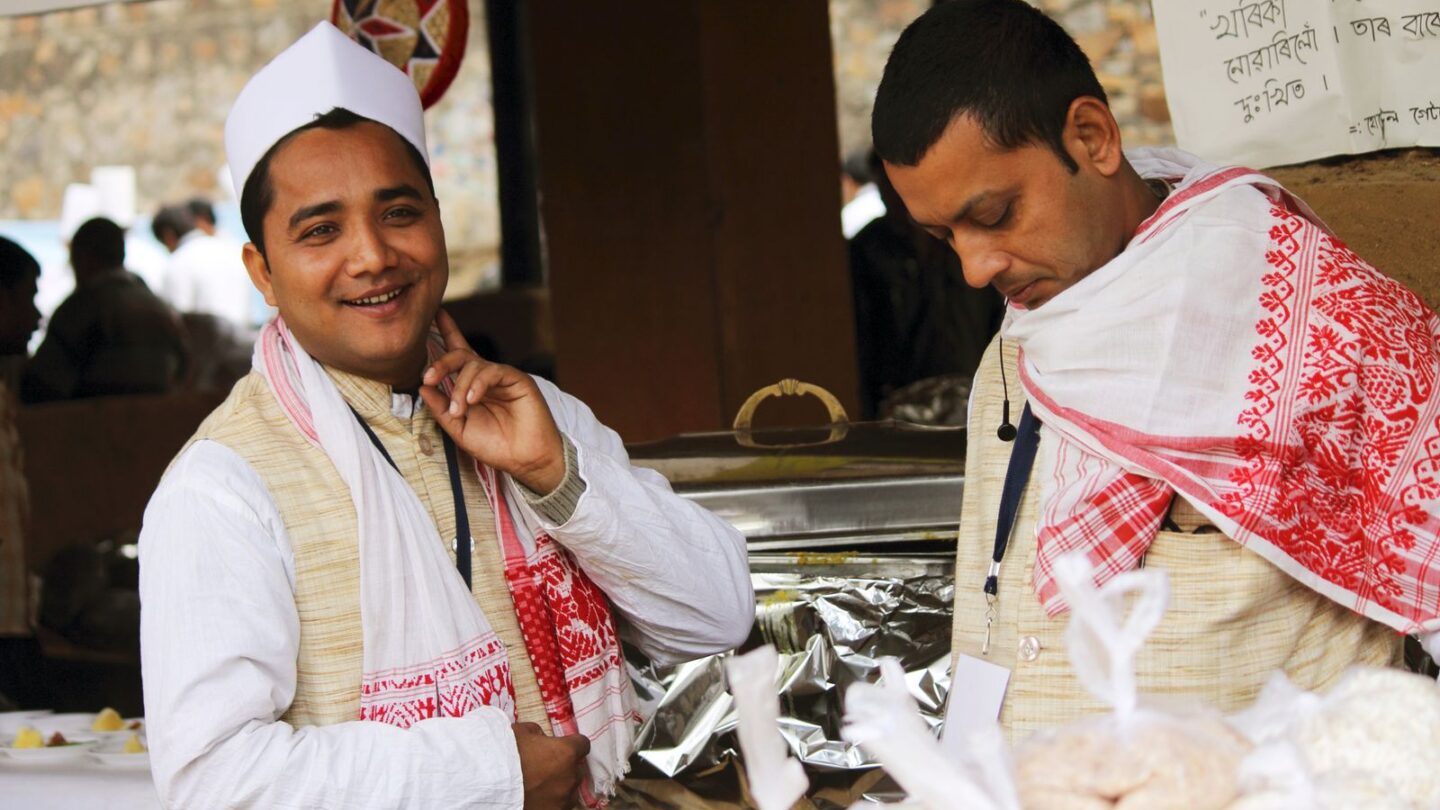
The main Assam language is Assamese (Oxomiya), the state’s official language and the mother tongue of about 48% of people in Census 2011. Bodo is an associate official language across the state, while Bengali serves as the official language in the three Barak Valley districts. Furthermore, the Centre granted Assamese classical language status in October 2024.
Assam is one of India’s most multilingual states. It holds Indo-Aryan languages such as Assamese, Bengali, Nepali and Sadri, alongside Tibeto-Burman languages such as Bodo, Mising, Karbi and Dimasa. Consequently, the Assam language picture changes from district to district, and many people speak two or three languages every day.
Key takeaways
- Assamese is the official language of Assam under the Assam Official Language Act, 1960.
- Bodo became an associate official language of the state in December 2020.
- Bengali is the official language of Cachar, Hailakandi and Sribhumi in the Barak Valley.
- Census 2011 recorded about 1.51 crore Assamese speakers, or 48.38% of the state.
- Assamese received classical language status from the Union Cabinet in October 2024.
Assam language at a glance
| Detail | Information |
|---|---|
| Main official language | Assamese (Oxomiya) |
| Associate official language (state-wide) | Bodo, since December 2020 |
| Official language in Barak Valley | Bengali (Cachar, Hailakandi, Sribhumi) |
| Associate official language in four districts | Manipuri, since August 2024 (Cachar, Sribhumi, Hailakandi, Hojai) |
| Governing law | Assam Official Language Act, 1960, as amended |
| Script for Assamese | Assamese script, from the Eastern Nagari family |
| Script for Bodo | Devanagari, adopted in 1975 |
| Assamese speakers (Census 2011) | About 1.51 crore, 48.38% of the state |
| Classical status | Granted to Assamese in October 2024 |
| Eighth Schedule languages widely used | Assamese, Bengali, Bodo, Hindi, Nepali, Manipuri, Santali |
What is the official Assam language?
Assamese is the official Assam language for most of the state. The Assam Official Language Act, 1960, made it the language of state administration. However, lawmakers later amended the Act several times to protect other communities.
The result is a layered Assam language system. Assamese applies across most districts, Bodo is an associate official language state-wide, and Bengali applies in the Barak Valley. Moreover, Manipuri now has associate status in four districts. English also continues for many official purposes.
In April 2025, the state cabinet went a step further. It made Assamese compulsory for official work across Assam, with two regional exceptions. The Barak Valley districts use Bengali alongside English, while the five Bodoland Territorial Region districts use Bodo alongside English. Additionally, the order asks for key notifications, rules and transfer orders in both English and Assamese.
| Language | Where it is official | Legal basis |
|---|---|---|
| Assamese | Whole state, except where other languages apply | Assam Official Language Act, 1960 |
| Bengali | Cachar, Hailakandi, Sribhumi (Barak Valley) | 1961 amendment and later changes |
| Bodo | Associate official language across Assam; main office language in BTR | Amendment passed 30 December 2020 |
| Manipuri | Associate official language in Cachar, Sribhumi, Hailakandi, Hojai | Amendment passed 29 August 2024 |
| English | Used alongside the above for official work | Continued under the 1960 Act |
Assam language census figures
The last complete Assam language data comes from Census 2011. The next census count is due in 2027, so these figures remain the latest official numbers. The table uses the census “language” groups, which bundle related mother tongues together.
| Language | Speakers (Census 2011) | Share of Assam | Change since 2001 |
|---|---|---|---|
| Assamese | About 1.51 crore | 48.38% | Down from 48.80% |
| Bengali | About 90.2 lakh | 28.91% | Up from 27.54% |
| Hindi (grouped) | About 21 lakh | 6.73% | Up from 5.89% |
| Bodo | About 14.2 lakh | 4.53% | Down from 4.86% |
| Mising | About 6.2 lakh | About 2% | Not compared here |
| Karbi | About 5.1 lakh | About 1.6% | Not compared here |
| Dimasa | About 1.3 lakh | Under 0.5% | Not compared here |
| Rabha | About 1 lakh | Under 0.5% | Not compared here |
The census counted 3.12 crore people in Assam in 2011. The Hindi group includes Sadri and several related mother tongues. Therefore, the count of people who name Hindi itself as their mother tongue is lower, at roughly 10 lakh. At mother-tongue level, Sadri had about 7 lakh speakers and Nepali about 6 lakh.
In contrast, these Assam language numbers only capture first languages. Assamese works as the common language across the Brahmaputra valley. As a result, far more than 48% of people understand and speak it as a second language.
History of the Assam language
The main Assam language, Assamese, grew out of Magadhi Apabhramsa, an eastern form of Prakrit. According to the Ministry of Culture, it had taken shape by about the 7th century. Furthermore, the Buddhist Charyapada verses of the 8th to 12th centuries contain words that are distinctly Assamese.
The language matured under the Ahom kings and the Vaishnavite saints. Srimanta Sankardev and his followers wrote plays, songs and scripture in Assamese in the 15th and 16th centuries. Consequently, the language gained a strong literary identity long before print arrived.
The Bengali period and its reversal
In 1836, the British administration made Bengali the language of courts and schools in the Brahmaputra valley. Assamese scholars and American Baptist missionaries protested for decades. The missionaries also launched Orunodoi in 1846, the first Assamese periodical, from Sivasagar. Eventually, in the 1870s, Assamese returned as the language of schools and local administration.
The 1960 Act and the Barak Valley
The Assam Assembly passed the Official Language Act on 24 October 1960. However, Bengali speakers in the Barak Valley opposed it strongly. On 19 May 1961, police firing at Silchar railway station killed eleven protesters. As a result, the Act was amended in 1961 to allow Bengali in Cachar, which then covered the whole valley. The day is still marked as Bhasha Shahid Divas in the Barak Valley.
Classical status for Assamese
The Union Cabinet granted Assamese classical language status in October 2024. It gave the same status to Marathi, Pali, Prakrit and Bengali in that decision. India now has 11 classical languages.
Classical status recognises a language’s long history and early literature. For the Assam language, it confirms more than a thousand years of written tradition. Moreover, it opens central funding for research, manuscript work and university chairs. Assam marked the decision with a Bhasha Gaurav Saptah, or language pride week, from 3 November 2024.
Assamese script and pronunciation
Assamese uses its own form of the Eastern Nagari script, which it shares with Bengali. The modern alphabet has 11 vowels and 33 consonants, plus many conjunct letters. However, two letters mark Assamese out clearly: ৰ (ro) and ৱ (wo). Similarly, Assamese treats ক্ষ (khya) as a full letter.
Before print, scribes used three styles: Garhgaya, Bamuniya and Kaitheli. The first printed Assamese Bible appeared in 1813. Additionally, the language has a notable sound feature. The letters for “s” and “sh” are usually spoken as a breathy “x” sound, close to the “ch” in the Scottish “loch”. That is why Assamese is written as “Oxomiya” and Assam as “Oxom” in many transliterations.
Other languages of Assam
Beyond the main Assam language, dozens of community languages thrive. Most belong to the Tibeto-Burman family, while others come from Indo-Aryan and Austroasiatic roots.
| Language | Family | Main areas | Notes |
|---|---|---|---|
| Bodo | Tibeto-Burman | Kokrajhar, Chirang, Baksa, Udalguri, Tamulpur | Written in Devanagari; Eighth Schedule since 2003 |
| Bengali | Indo-Aryan | Barak Valley and parts of lower Assam | Sylheti is widely spoken in the Barak Valley |
| Mising | Tibeto-Burman (Tani) | Dhemaji, Lakhimpur, Majuli, Jorhat | Spoken along the Brahmaputra’s riverbanks |
| Karbi | Tibeto-Burman | Karbi Anglong, West Karbi Anglong | Language of a Sixth Schedule council area |
| Dimasa | Tibeto-Burman | Dima Hasao, parts of Cachar and Hojai | Closely related to Bodo |
| Rabha | Tibeto-Burman | Goalpara, Kamrup | Community also lives in Meghalaya |
| Tiwa | Tibeto-Burman | Morigaon, Nagaon, Karbi Anglong | Many Tiwa people now speak Assamese at home |
| Sadri | Indo-Aryan | Tea garden areas of upper and central Assam | Link language of the tea communities |
| Nepali | Indo-Aryan | Scattered across the state | Eighth Schedule language |
| Santali | Austroasiatic | Kokrajhar, Chirang, Sonitpur | Eighth Schedule language |
Many smaller languages face decline, even as the main Assam language grows in official use. For example, the Tiwa and Deori communities each had only around 30,000 speakers in 2011. Consequently, community groups now run primers, radio programmes and summer classes to keep them alive.
Assam language in the Barak Valley and Bodoland
The Barak Valley in the south forms a distinct Assam language zone. Cachar, Hailakandi and Sribhumi use Bengali for official work, and Sylheti dominates daily speech. Moreover, Silchar is the valley’s main city and its link to Tripura, Mizoram and Manipur. Our guide to the districts of Assam lists all three districts with their headquarters.
Bodoland, in the north-west, is another distinct zone. The Bodoland Territorial Region uses Bodo alongside English for official work. Furthermore, Bodo-medium schools run up to higher classes in many parts of the region. Therefore, visitors to Kokrajhar or Udalguri will hear Bodo much more than Assamese in villages.
Useful Assamese phrases for travellers
A few words of the local Assam language go a long way in markets, homestays and taxis. Transliterations vary, so treat the spellings below as a pronunciation guide.
| English | Assamese (Roman) | Assamese script |
|---|---|---|
| Hello (respectful) | Nomoskar | নমস্কাৰ |
| How are you? | Apuni kene ase? | আপুনি কেনে আছে? |
| I am fine | Moi bhale asu | মই ভালে আছোঁ |
| Thank you | Dhonyobad | ধন্যবাদ |
| What is your name? | Apunar naam ki? | আপোনাৰ নাম কি? |
| My name is … | Mur naam … | মোৰ নাম … |
| Yes / No | Hoy / Nohoy | হয় / নহয় |
| How much is this? | Iyar daam kiman? | ইয়াৰ দাম কিমান? |
| I cannot speak Assamese | Moi Oxomiya kobo nuwaru | মই অসমীয়া ক’ব নোৱাৰোঁ |
| See you again | Akou dekha hobo | আকৌ দেখা হ’ব |
Use “apuni” for elders and strangers, because it is the respectful form of “you”. In contrast, “tumi” suits friends and people your own age. Additionally, English and Hindi work well in Guwahati hotels, shops and taxis.
How the Assam language shapes culture and festivals
Assamese culture lives through the Assam language. Bihu songs, Borgeet hymns and Ankiya Naat plays all use Assamese or its older literary form, Brajavali. Similarly, the Assamese solar calendar sets festival dates, from Bohag Bihu in April to Kati Bihu in October.
Other communities keep their own traditions in their own languages. For instance, the Bodo celebrate Bwisagu, and the Mising celebrate Ali-Ai-Ligang. Meanwhile, neighbouring states have their own language maps. Our guide to the Seven Sisters of India sets out the capitals and key facts of each state.
Assam language for exams and jobs
State recruitment often tests the Assam language. Many Assam government job notices ask for working knowledge of Assamese or another state language, such as Bodo. Rules differ by post, so read each notice carefully. Candidates preparing for the ADRE exam should check the language rules in each advertisement.
Assam language questions in exams often cover the Official Language Act, the 1961 Silchar protests and the 2024 classical status. Furthermore, they ask about Bodo’s Eighth Schedule inclusion and its Devanagari script. Therefore, learn these dates alongside the list of Northeast states and capitals.
Common mistakes about the Assam language
- Calling Assamese a dialect of Bengali: Assamese is a separate language with its own history and literature.
- Saying Assamese is the only official language: Bodo, Bengali and Manipuri also hold official roles.
- Using Karimganj: the Barak Valley district is officially Sribhumi since November 2024.
- Quoting Bodo as written in Roman script: Bodo uses Devanagari for official and school use.
- Treating 2011 figures as current: new census data is due only after the 2027 count.
- Assuming Hindi works everywhere: it helps in cities, but villages rely on local languages.
Frequently asked questions
What is the main language of Assam?
Assamese is the main Assam language and the official language of most of the state. Census 2011 recorded about 1.51 crore Assamese speakers, or 48.38% of the population. Many more people speak it as a second language. Bodo is an associate official language, and Bengali is official in the three Barak Valley districts.
How many official languages does Assam have?
Assam has several official languages under the Official Language Act, 1960, as amended. Assamese applies across most of the state. Bodo is an associate official language state-wide since December 2020. Bengali is official in Cachar, Hailakandi and Sribhumi. Manipuri became an associate official language in four districts in August 2024. English continues for many official purposes.
When did Assamese get classical language status?
The Union Cabinet granted Assamese classical language status in October 2024. Marathi, Pali, Prakrit and Bengali received the same status in that decision, which took India’s total to 11 classical languages. The Ministry of Culture traced Assamese back to the Charyapada verses and noted its distinct form by the Sankardev era.
Which script is used for Assamese?
Assamese uses the Assamese script, a member of the Eastern Nagari family that it shares with Bengali. The modern alphabet has 11 vowels and 33 consonants. The letters ৰ (ro) and ৱ (wo) are unique to Assamese. Bodo, in contrast, uses Devanagari, which the Bodo Sahitya Sabha adopted in 1975.
Is Bengali an official language in Assam?
Yes. Bengali is the official language of the three Barak Valley districts: Cachar, Hailakandi and Sribhumi, formerly Karimganj. The change followed the 1961 language protests in Silchar. Under an April 2025 order, these districts use Bengali alongside English for official work, while most of Assam uses Assamese.
Can tourists manage in Assam without Assamese?
Yes. Tourists can manage well with English and Hindi in Guwahati, Kaziranga, Tezpur and Jorhat. Hotel staff, taxi drivers and shopkeepers usually understand both. However, a few Assamese words such as “nomoskar” and “dhonyobad” earn warm smiles. In remote villages, a local guide helps with Mising, Karbi or Bodo speakers.
What languages are spoken in Bodoland?
Bodo is the main language of the Bodoland Territorial Region, which covers Kokrajhar, Chirang, Baksa, Udalguri and Tamulpur. Official work there uses Bodo alongside English. However, the region is mixed, so Assamese, Bengali, Santali, Rabha and Nepali are also common. Many residents switch between two or three languages in daily life.
Understand the Assam language before you travel
The Assam language story centres on Assamese, a classical language since 2024, with Bodo, Bengali and Manipuri holding official roles in their regions. Learn a few greetings before your trip, and check the best time to visit Northeast India to plan around the monsoon and festival season.
Explore more state guides in Northeast Guides or visit the Frontier News homepage.
Related guides
More in Northeast Guides →
Northeast Guides
Northeast States and Capitals: Complete List with Key Facts
Northeast Guides
Districts of Assam: Full List of 35 Districts with Headquarters
Northeast Guides